
From online workouts, to youth group services, to pleas for more business, the crisis communication methods and results for businesses and nonprofits during the COVID-19 pandemic are all varying, but have the same goal of remaining a viable business.
For this assignment, I looked at three familiar northwest Omaha businesses and non-profits: Stonebridge Church, Premier Gymnastics and Raising Canes restaurant. I have received emails from all three in the last month, and thought I’d compare them.
From my perspective, two the three seem to be handling the situation to the best of their abilities and adapting. The other, Canes, doesn’t seem to have much of an online presence; but cars are still going through their drive-thru because people do like their product.
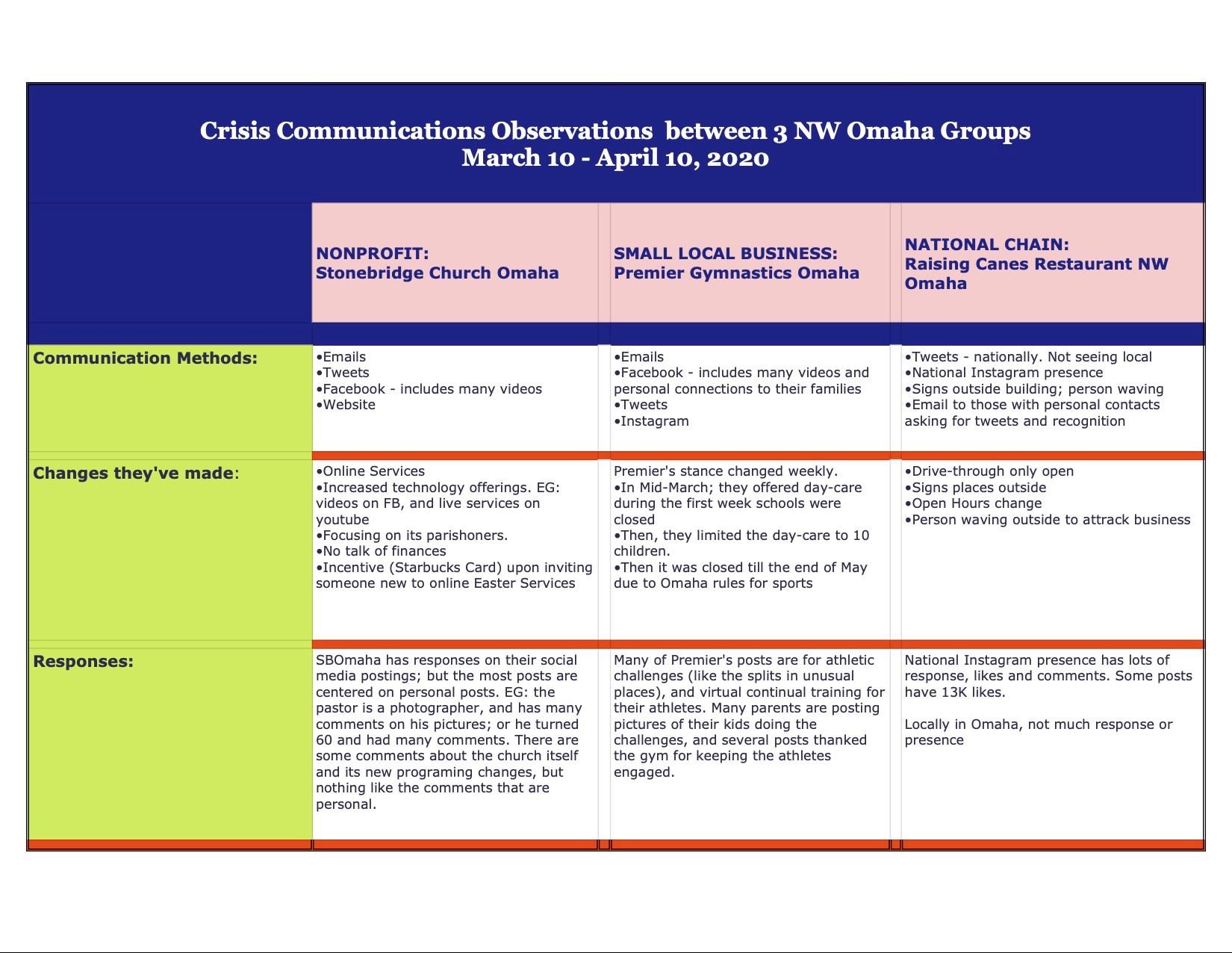
My thoughts on these three:
SBOmaha: This large urban church is trying to grow its membership and share its message focusing on a younger crowd. It’s very technologically savvy; so the change to online services was probably not too difficult as the church already audio records all services and has video staff.
The service I watched live was seamless; good quality, it provided an online chat during the service; and they offered a Zoom “party” to connect with others afterwards. They’ve offered Instagram youth contests and games and have featured all sorts of interviews and drive through events online. Really, this is pretty smooth.
Its Starbucks gift card promotion over Easter is two-fold. My guess: trying to share its message, and gain new members at the same time. The church has a Sunday morning coffee bar, so the theme fits in, although the promotion seemed slightly odd in my point of view.
I’m guessing the church is concerned about finances and giving as it completely relies on donations for its operations, and it has had no on-site services for a month. However, years ago the church designed an app for regular giving, and it’s used widely. At this point, no communication has focused on giving/funds. I have heard of other churches laying off staff; at this point Stonebridge has not.
GRADE: A. They are doing a good job under the circumstances. I’m basing this off their interaction, consistent communications, and no monetary pleas. Facebook link here.
Premier Gymnastics: Premier Gymnastics is a small, two-owner business in NW Omaha. Its members sign yearly contracts for its servicess of youth gymnastics and other similar sports. Its contact via email and Facebook is mainly with parents; its Twitter and Instagram pages are aimed at both parents and youth.
During the last month, I started watching their communications and plans as I am on their email list. I know this group is concerned with the bottom line from interaction with them the last 15 years. Their plans for day care kept slimming down over the last month, but they started off optimistically.
They have built-in members, and right now really aren’t focused on gaining new members, but rather keeping their families happy. These members pay monthly contract fees, and for the first time ever, they are giving those families a tuition break for the month of May. They have offered many classes online for at-home practice.
GRADE: A. Good crisis communication, and they are being adaptable to keep their customers happy; although it is costing them, I’m sure.
Raising Canes NW Omaha: Raising Cane’s in NW Omaha has donated to my volunteer group; and along with many others throughout Omaha we received an email plea for help in return for their donation last year. Fair is Fair, smart idea. From that, I have seen a few social media requests to encourage drive-thru patronage from different groups throughout the metro area.
But besides that, I am not seeing much talk about Raising Cane, and I see very little information or presence from the local restaurant. Nationally on Instagram they are active and well liked but locally, there’s just an upkept Facebook page, and a few tweets.
It’s a completely different business model of course than the other two above groups. They did make an effort to reach out; however I hope they can locally do more to keep their business viable.
GRADE: C- Locally they are struggling; nationally they are staying strong.











 Media Portfolio